

Best CNC Lathe Machines for Precision Turning and High Efficiency
2026-07-23
Precision turning demands more than just a machine—it requires a partner in productivity. As manufacturers push for tighter tolerances and faster cycle times, the right CNC lathe becomes the heart of the shop floor. From complex contours to high-volume production, today’s top choices blend rigidity, smart controls, and energy efficiency. Among them, WINNRUI CNC stands out by redefining what’s possible with adaptive cutting technology and robust construction. In this guide, we’ll explore the finest CNC lathe machines that elevate your turning operations from standard to exceptional—so you can stay ahead in a competitive landscape.
Key Features to Look for in a Top-Notch CNC Lathe
When evaluating a CNC lathe, precision starts with the spindle and the machine's structural integrity. A high-quality spindle should deliver consistent torque across a wide RPM range, and its bearings—ideally ceramic hybrid types—must handle both heavy cuts and fine finishing without compromising accuracy. Equally critical is the bed and base construction; cast iron frames with optimized ribbing dampen vibration far better than welded assemblies, directly affecting surface finish and tool life. Don't overlook linear guide systems either—roller-type guides often outperform ball guides in rigidity, making them a better choice for interrupted cuts or hard materials.
The control system and tooling interface are also make-or-break factors. A responsive CNC with features like tool load monitoring and thermal compensation can save scrapped parts and reduce operator intervention. Look for a turret design that places the tool close to workpiece centerline to minimize those tiny moment-induced deflections during turning. If you're planning to run unattended, a bar feeder interface and reliable chip management system become essential; otherwise, even the most accurate lathe will bottleneck your workflow with constant operator stops.
How Rigidity and Construction Impact Turning Accuracy
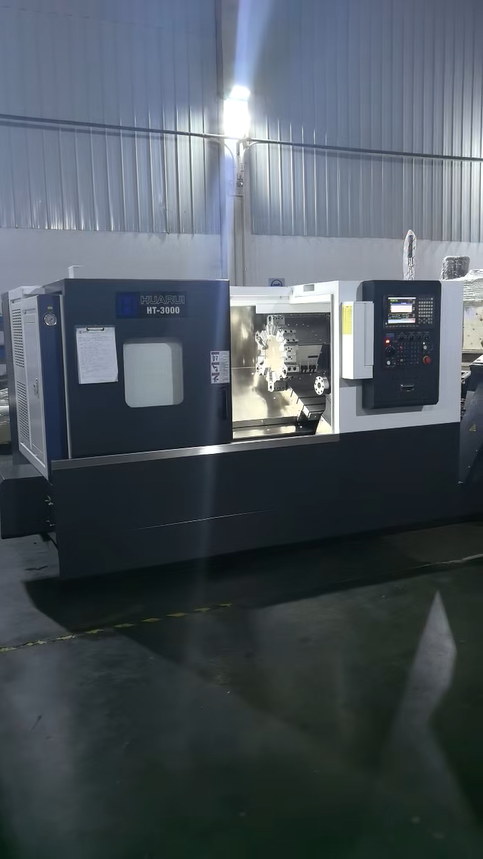
When we talk about precision in turning, the conversation often zeroes in on tooling or operator skill, but the foundation of consistent accuracy lies in the machine's structural integrity. Rigidity isn't just about heavy castings—it's how effectively the frame, spindle, and guideways work together to resist deflection under load. Even minute flex during a cut can translate into tapered diameters, poor surface finish, or positional drift. A well-constructed lathe absorbs and dampens vibrations rather than transmitting them, which directly influences how faithfully a programmed toolpath becomes a tangible workpiece.
The interplay between static stiffness and dynamic behavior separates truly capable machines from the rest. Static rigidity determines how much the structure bends under steady cutting forces, while dynamic rigidity—often overlooked—dictates how it reacts to interrupted cuts or resonance. A machine designed with optimized ribbing in the bed, a properly preloaded spindle, and robust linear guides won't just hold tighter tolerances; it will do so consistently over long production runs. Without this inherent stability, no amount of compensation or fine-tuning can fully overcome the fundamental limitations of a flexible frame.
Material choices and assembly techniques further elevate performance. Hand-scraped mating surfaces, thermosymmetric design to minimize thermal growth, and the use of polymer concrete or mineral cast composites in the base are not marketing gimmicks—they're practical solutions that dampen chatter and extend tool life. In the end, a turning machine's accuracy envelope is defined long before the first chip is made, etched into its blueprint by the decisions around how rigidly and thoughtfully it was put together.
Spindle Speeds, Tooling, and the Art of Efficient Material Removal
Getting the most out of a machining operation often comes down to the interplay between spindle speed and tooling. Turning the spindle faster might seem like a shortcut to removing material quickly, but without the right cutter geometry or coating, you'll just generate heat and wear out the tool prematurely. The sweet spot isn't a fixed number—it shifts depending on the material's hardness, the tool's diameter, and how rigid your setup is. Start with the manufacturer's surface speed recommendations, then watch the chips. Long, curled chips usually indicate you're in the right zone; fine dust or short, brittle fragments often signal excessive speed or a dull tool.
Tool selection feeds directly into this balance. A high-helix end mill can evacuate chips faster in aluminum, letting you push the feed rate up without clogging flutes. In stainless, a variable-flute design reduces chatter and lets you hold a higher RPM without resonance issues. Don't ignore the holder, either—a hydraulic or shrink-fit setup transmits power more cleanly than an old collet chuck, keeping cutters cutting instead of wobbling. Small improvements here compound into noticeable material removal gains without forcing you to spin the spindle any faster.
The real art lies in listening to the process. A machine that's humming along at the right parameters sounds steady, almost musical. When the pitch changes or vibrations creep in, it's time to adjust—maybe drop the speed slightly or swap to a sharper edge. Efficient material removal isn't about brute force; it's about sustaining a cut that makes the most of each revolution. By pairing a solid understanding of your tooling with a willingness to tweak speeds on the fly, you'll pull more metal out faster, and your tools will last longer in the bargain.
Automation and Software: Streamlining Your Workflow
At the heart of modern efficiency lies the clever pairing of automation and smart software. Instead of spending hours on repetitive data entry or switching between a dozen tools, you can let interconnected apps handle the heavy lifting. The goal isn't to replace human judgment—it’s to free you from the tiny, time-consuming tasks that slowly drain your energy over a workday. By mapping out your routine processes and identifying bottlenecks, you can weave together simple triggers and actions that make everything flow almost unnoticed in the background.
What often surprises people is how accessible these tools have become. You don't need a developer to set up a system that, for example, automatically saves email attachments to your cloud storage, notifies your team in a chat app, and updates a project tracker—all in one go. The real magic happens when these automations stack together, turning a sequence of manual steps into a single, reliable rhythm. It’s less about flashy tech and more about thoughtfully designing a workspace where the routine stuff just gets done, so you can focus on the work that actually needs your brain.
The most overlooked part of streamlining a workflow is the maintenance of the automations themselves. A good setup isn’t a one-time event; it’s something you tweak and improve over time as your needs shift. When you regularly revisit your digital pipelines, you catch small inefficiencies before they become headaches. This ongoing refinement keeps your workflow from feeling rigid, letting you adapt quickly without starting from scratch. Ultimately, the measurement of success isn’t how many tasks you’ve automated—it’s how much clearer your day feels when the tools you rely on quietly do their job.
Real-World Applications: From Automotive to Medical Parts
The shift toward high-performance polymers and additive manufacturing has blurred the lines between prototyping and production across industries. In automotive, lightweight components like intake manifolds and ducting are now routinely 3D-printed in nylon or fiber-reinforced materials to slash vehicle weight without sacrificing durability. Meanwhile, the medical sector leverages biocompatible resins for patient-specific surgical guides, dental aligners, and even implantable devices that match an individual's anatomy precisely. This crossover isn't just about materials—it's reshaping how engineers think about part consolidation, reducing assembly steps by printing complex geometries that were once impossible to machine.
Beyond automotive and healthcare, the same digital manufacturing workflows are proving indispensable in aerospace for low-volume, high-value brackets and housings, and in consumer electronics for durable, thin-walled enclosures. What ties these applications together is the ability to iterate rapidly based on real-world testing feedback, turning months of tooling lead time into days. A ventilator manifold that once required six machined components and multiple seals can now emerge as a single, sterilizable print. These aren't just cost savings—they enable designs that are safer, lighter, and often perform better because the constraints of traditional manufacturing no longer dictate form.
The real story, though, lies in the supply chain resilience these technologies offer. When a hospital runs low on a specific clamp or an automaker faces a supplier bottleneck, localized 3D printing fills the gap without the need for massive inventory. It's not about replacing mass production wholesale but about augmenting it where flexibility matters most. From coolant-resistant connectors under the hood to transparent aligners in a dental lab, the common thread is a move toward on-demand, fit-for-purpose manufacturing that quietly keeps things moving behind the scenes.
Maintenance Tips to Keep Your Lathe Running Like New
A lathe that’s treated with a bit of daily respect will repay you with years of silky-smooth operation. Before you even think about hitting the power switch, take a slow walk around the machine. Look for anything out of place—chips packed into crevices, a faint drip of oil where there shouldn’t be one, or a tool post that’s just a hair looser than yesterday. Wipe down the ways with a clean, lint-free rag and check the wipers; these little felt guardians are your first line of defense against abrasive grit. A quick squirt of way oil on the sliding surfaces isn’t just a chore—it’s an insurance policy against premature wear that feels invisible until it isn’t.
The coolant system often gets overlooked until something goes sour, but it deserves a regular ritual. Old coolant turns into a bacterial stew that can corrode your machine from the inside out. Once a month, dip a refractometer into the sump and make sure the concentration matches the manufacturer’s sweet spot—usually between 5% and 10% depending on your fluid. Skim off any tramp oil floating on top; that gunk is a magnet for fine particles that will eventually find their way into precision bearings. If the fluid starts smelling like a wet basement, don’t mask it with additives—drain it, flush the tank, and start fresh. Your lungs and your lathe will both thank you.
Don’t let the tailstock and chuck become afterthoughts. A chuck with even a tiny bit of internal rust or embedded swarf will struggle to hold concentricity, turning what should be a ten-minute job into an afternoon of frustration. Pop the jaws out on a regular schedule, clean every tooth and scroll with a stiff brush, and apply a thin film of high-pressure grease before reassembly. For the tailstock, extend the quill fully and inspect for scoring or dryness; if it feels lumpy when you retract it, you’ve got contamination hiding under the wiper seal. A few minutes spent here on a Friday afternoon can prevent that dreaded Monday morning surprise when a finish cut suddenly looks more like a thread.
FAQ
For precision turning, look for machines with high-resolution encoders, rigid construction to minimize vibration, and linear guide ways. Thermal stability systems and high-quality spindle bearings also play a big role in maintaining tight tolerances over long runs.
It's all about the control system and drive motors. A CNC lathe with a fast, responsive servo system and high acceleration rates can maintain accuracy even at high speeds. Also, features like automatic tool changers and bar feeders reduce idle time without sacrificing precision.
Yes, brands like Haas, DMG Mori, and Okuma have strong reputations. They build machines with rugged castings, powerful spindles, and robust turrets that handle heavy cuts day in and day out. It's worth looking at user reviews for long-term durability.
The controller is the brain. Conversational programming interfaces, like those on Fanuc or Siemens controls, can speed up setup. Macros and canned cycles simplify complex operations, while adaptive feed rate control adjusts on the fly to optimize cutting conditions.
Very important. A high-torque, low-vibration spindle motor delivers consistent power across a wide RPM range. For fine finishes and intricate parts, you want a spindle with minimal runout and the ability to hold constant surface speed during facing operations.
Entry-level machines can hold decent tolerances for many jobs, but if you're working in microns or with exotic materials, a mid-range to high-end model with linear scales and advanced thermal management is a better investment. It really depends on your typical workpiece requirements.
Regularly check and adjust backlash, keep the guide ways clean and lubricated, and monitor coolant concentration. Aligning the tailstock and inspecting belts and pulleys for wear also prevent drift in precision. A scheduled maintenance log is a must.
Absolutely. A Y-axis allows off-center milling, drilling, and tapping in one setup. This reduces part handling and increases accuracy for features not aligned with the spindle centerline, making it a game-changer for parts with cross-holes or flats.
Conclusion
Selecting the best CNC lathe for precision turning and high efficiency demands a close look at the machine’s core attributes. Rigidity and robust construction form the backbone of turning accuracy, minimizing vibration and deflection even during heavy cuts. Equally critical is the spindle—high torque at low RPMs paired with rapid acceleration enables faster cycle times while maintaining surface finish quality. The tooling setup, from live tooling to quick-change turrets, directly influences how efficiently material is removed, turning complex geometries into straightforward operations. Modern CNC lathes integrate smart software and automation features like bar feeders, parts catchers, and real-time monitoring, which streamline workflow and reduce human error, allowing lights-out production to become a reality rather than a distant goal.
These technical capabilities translate into real-world versatility across industries—from producing tight-tolerance automotive shafts to intricate medical implants. Advanced conversational programming and AI-driven tool path optimization further shorten setup times, enabling shops to pivot quickly between jobs without sacrificing accuracy. Maintenance also plays a silent but pivotal role: regular calibration, fluid checks, and predictive alerts keep the machine running like new, preserving its precision over years of heavy use. A truly top-notch CNC lathe blends raw power with intelligent control, turning high-mix, low-volume challenges into profitable opportunities. Ultimately, the right machine isn’t just a tool; it’s a partner in achieving consistent, micron-level accuracy while pushing output to new limits.
Contact Us
Contact Person: Tim
Email: [email protected]
Tel/WhatsApp: +86 15522553731
Website: https://www.winnrui-cnc.com/