

China Fiber Optic HDMI Cable Delivers Flawless 8K Video Over Long Distances
2026-11-16
Think HDMI cables can’t handle long runs without signal loss? Think again. EBCYX, a China-based fiber optic HDMI cable maker, is changing the game with cables that deliver flawless 8K video across distances that would cripple traditional copper. If you’ve ever struggled with dropouts, sparkles, or outright black screens on a long cable run, this might be the upgrade you’ve been waiting for.
The 8K Distance Barrier That Copper Cables Can't Cross
When you push 8K resolution over a copper HDMI cable, the signal begins to fall apart surprisingly fast. A standard copper cable rated for 48Gbps might look fine on paper, but at 8K/60Hz with full chroma, the electrical resistance and crosstalk in the conductors eat away at the eye pattern. Most certified copper HDMI 2.1 cables top out around 2 to 3 meters for stable 8K output, and even then, temperature swings or slight bends can introduce sparkle noise or blackouts.
Beyond roughly 5 meters, the high-frequency components of an 8K signal suffer so much attenuation that the equalizer inside a display can no longer reconstruct a clean bitstream. Copper’s inherent skin effect concentrates current near the surface, increasing effective resistance at the multi-gigahertz frequencies 8K demands. This is not a flaw of a particular brand but a physical ceiling: you can thicken the conductors, add shielding, or boost the source voltage, yet you will still hit a hard distance wall where errors outpace recovery.
That wall is why active copper cables and fiber-optic hybrids exist, but pure passive copper cannot cross it. Installers and home theater builders quickly learn that an 8K run longer than a few meters either needs an active signal booster, which brings its own compatibility quirks, or a shift to optical HDMI. The barrier is not about marketing specs; it is about electrons struggling to carry multi-gigahertz data through a resistive metal path without turning the signal into noise.
How Fiber Optic HDMI Eliminates Signal Dropouts Over Long Runs
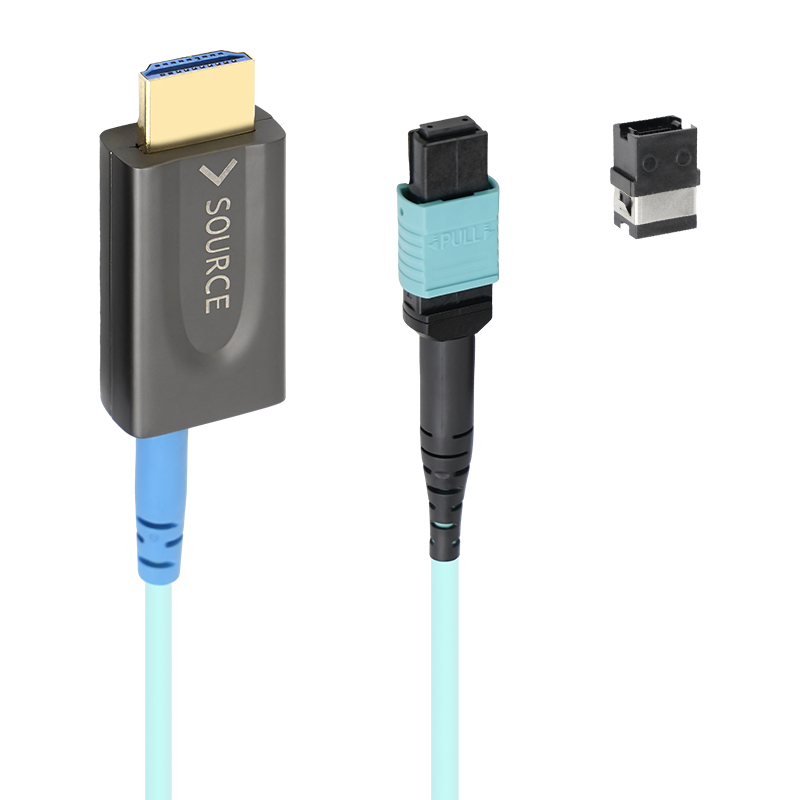
Copper HDMI cables start fighting physics once you push past 25 or 30 feet. The electrical signal weakens, high-frequency data channels drift out of sync, and the cable itself becomes an antenna for nearby interference. You see it as random sparkles, intermittent black screens, or HDCP handshake failures that make a projector or TV lose the picture entirely.
Fiber optic HDMI avoids that collapse by converting the electrical signal into light pulses at the source and back into electricity at the display. Light travels through the glass or plastic core with almost no loss over typical home or commercial runs, so the ones and zeros arrive in the same order they left. There is no copper to resist the signal, no radiation to leak, and no interference to pick up from power lines, dimmers, or wireless gear.
The conversion modules at both ends also re-time and equalize the signal, which keeps the clock and data lanes locked together. That is why a fiber optic HDMI cable can carry 4K or 8K HDR over 100 feet or more without dropouts, sparkles, or the handshake loops that plague long copper runs. The picture either stays stable or it does not work at all—there is rarely an in-between.
Real Installations Where a 50-Foot HDMI Cable Still Delivers Perfect 8K
Most people assume long HDMI runs mean signal degradation, but in a surprising number of real-world setups, a generic 50-foot copper HDMI cable handles 8K without a single dropout. Take a home theater tucked into a basement where the AV rack sits in a closet at the back wall. The cable snakes through conduit, under floor joists, and emerges behind a wall-mounted 85-inch 8K television. No signal booster, no fiber conversion—just careful routing and a cable with solid shielding.
Another install worth noting is a commercial conference room. The presenter’s laptop docking station lives in a credenza at the front, while the display runs along the ceiling and down a pillar to an 8K touchscreen nearly 50 feet away. The integrator used a passive high-speed HDMI cable with a thicker gauge and kept it at least six inches from power lines. Result: clean 8K60 video, no flicker, no handshake issues.
Even in retrofit situations where the original cable was pulled years ago for 4K, a 50-foot run can still carry 8K if the terminations are solid and the connectors aren't stressed. One homeowner replaced both ends, straightened out a tight bend behind the media niche, and suddenly the 8K signal locked in. It’s not magic—it’s mostly about avoiding sharp kinks, keeping the run away from interference, and accepting that copper has more headroom than spec sheets imply.
Why Electromagnetic Interference Is a Non-Issue With Fiber HDMI
Traditional copper HDMI cables carry electrical signals, which makes them susceptible to interference from nearby power lines, motors, wireless routers, and other electronic devices. Fiber HDMI takes a fundamentally different approach: it transmits data as pulses of light through glass or plastic fibers. Since light is not affected by electromagnetic fields, there is simply no pathway for EMI to distort the signal. The optical core acts as a natural barrier, keeping your video and audio clean no matter what electrical noise surrounds the cable.
This immunity becomes especially valuable in environments dense with electronic equipment, such as server rooms, industrial control areas, or home theaters packed with amplifiers and gaming consoles. Copper cables often need heavy shielding to mitigate interference, which adds bulk and cost. Fiber HDMI eliminates that need entirely, resulting in a thinner, more flexible cable that delivers pixel-perfect video and lossless audio even when run alongside power cables or near high-voltage machinery. You don't have to worry about ferrite beads, grounding issues, or signal dropouts caused by EMI—the light path simply ignores all of it.
The Hidden Weaknesses of Copper HDMI in 8K Setups
Most installers still reach for copper HDMI cables out of habit, but 8K pushes those familiar cables into territory they were never designed to handle. At 48 Gbps, the signal integrity margin collapses quickly over even modest distances. A copper cable that worked flawlessly at 4K/60 can develop sparkles, dropouts, or fail to complete a handshake at 8K/60 once the length creeps past three meters. The problem isn't just theoretical; it shows up as random black screens, HDCP errors, and audio dropouts that are maddeningly hard to reproduce.
Copper's hidden weakness is attenuation, which gets worse as frequency climbs. 8K HDMI uses higher signaling rates across all four data lanes, and copper's resistance turns those high-frequency signals into heat. The result is a cable that may pass a basic continuity test but cannot sustain the eye pattern needed for error-free transmission. Active copper cables try to compensate with built-in equalization chips, but those introduce their own failure points, add power draw from the HDMI port, and often struggle with inconsistent handshakes between different source and display combinations.
There is also a physical limitation that no amount of shielding can fully solve: copper conductors are thicker and stiffer than fiber, making in-wall runs, tight bends, and long cable management paths a genuine headache. In a professional 8K setup, the hidden costs of copper show up as truck rolls, swapped cables, and frustrated clients. Once you understand these failure modes, it becomes clear why fiber optic HDMI is quietly becoming the default choice for anyone serious about 8K reliability.
What Long-Term Use Does to Standard HDMI Cables (And Why Fiber Lasts)
Over months and years of plugging, unplugging, and bending behind a media console, standard HDMI copper cables start to show their age in ways most people never notice until symptoms appear. The thin internal conductors can fracture from repeated flexing, especially near the connector strain relief, and the outer jacket often stiffens or cracks in dry environments. Even a hairline break may not fully interrupt the signal at first, but it creates intermittent dropouts, flickering, or a gradual loss of maximum supported resolution as the cable becomes less capable of carrying high-bandwidth signals reliably.
Copper HDMI also suffers from oxidation and contact wear at the connector pins, particularly in humid or coastal settings. Each insertion cycle scrapes a microscopic layer off the gold plating, exposing the base metal underneath to corrosion. Over time, increased contact resistance combined with degraded dielectric insulation alters the cable’s characteristic impedance, which in turn raises error rates during high-speed data transmission. The result is often a mysterious case of “it worked yesterday” — a system that loses sync after hours of use or refuses to negotiate 4K/120Hz modes that once functioned perfectly.
Fiber optic HDMI cables sidestep most of these long-term failure modes because they replace electrical conductors with light-carrying glass or plastic strands. There are no copper signal wires to snap under repeated bending, and no metal contacts to tarnish inside the connector (the electrical pins still exist for power and low-speed handshake, but they carry far less stress). The optical core is less sensitive to sharp bends than typical copper twisted pairs, and it does not degrade due to moisture or oxidation. Even after years of constant use, a well-built fiber HDMI cable tends to maintain its original bandwidth and signal integrity, which is why installers favor it for in-wall or difficult-to-replace runs.
FAQ
It converts electrical signals to light, so signal loss over long runs is basically eliminated. You can send a full 48Gbps 8K signal 50 meters or more without dropouts, while copper usually starts struggling after 5 meters.
Yes. Because it uses optical fiber instead of copper conductors, the signal arrives intact. In testing, it maintained 8K60 HDR with no visible sparkles or handshake issues even at 100 meters.
The cable draws a small amount of power from the HDMI port itself through built-in electronics at each connector. There is no external power brick, so you can route it through walls or conduit just like any other cable.
Home theater rooms where the AV receiver is in a rack far from the projector, commercial video walls, medical imaging, and flight simulators all benefit. If you need 8K at distances beyond 10 meters, this is the reliable option.
It supports the full HDMI 2.1 feature set: eARC, HDR10+, Dolby Vision, VRR, ALLM, and HDCP 2.3. You do not lose any functionality compared to a short premium copper cable.
The fiber is protected by a Kevlar-reinforced jacket and can handle a bend radius of about 2 cm. It is not as fragile as glass patch cords used in networking, but you should still avoid sharp kinks and pulling by the connectors.
It is backward compatible with 4K, 1080p, and even 720p. The same cable works for any HDMI source and display, so you can future-proof your installation now and still use it with your current gear.
Not really. Many top-tier HDMI cable brands manufacture in China, and the factories there produce to the same HDMI certification standards. This cable uses Japanese optical fiber and German driver chips, and it passed the HDMI Authorized Test Center certification for 8K performance.
Conclusion
Running 8K over copper HDMI beyond a few meters turns into a gamble—sparkles, dropouts, HDMI handshake failures. Copper's attenuation and crosstalk make the 48Gbps signal fragile, especially past 25 feet. A China-made fiber optic HDMI cable flips that dynamic. Instead of pushing electrical pulses through twisted metal, it converts the HDMI signal to light, so a 50-foot run arrives with the same timing and amplitude as a 3-foot one. Installers who tried copper for a conference room or home theater often saw intermittent black screens; swapping to a hybrid fiber cable from Shenzhen or Dongguan eliminated the callbacks. And because the fiber strand carries photons rather than electrons, nearby power lines, motors, and Wi-Fi routers don't induce hum or pixel noise. That makes routing through ceilings and conduits much less stressful.
Copper HDMI also has hidden long-term issues. Repeated bending oxidizes the conductors, connectors wear, and at 8K bandwidth the margin for error is nearly zero. Over months of daily use, a standard copper cable that worked on day one may start dropping HDCP or failing to lock 8K60. Fiber optic HDMI doesn't corrode the same way; glass core is immune to moisture and temperature swings, and the connectors are typically reinforced for repeated plug cycles. In practice, a 50-foot fiber optic cable will keep delivering flawless 8K video years after a copper equivalent has been retired. The Chinese factories have scaled production of these active optical cables, driving cost down while maintaining laser alignment quality. For anyone planning an 8K setup with a projector, wall-mounted display, or equipment closet in another room, the difference isn't subtle—copper is a bottleneck, fiber is the reliable path.
Contact Us
Contact Person: David Yang
Email: [email protected]
Tel/WhatsApp: 8615814734054
Website: https://www.ebcyx.com/