

Custom Rigid Chain Lift System How It Works and Where It Excels
2026-11-18
Rigid chain lifts solve a problem most designers accept too quickly: how to get true vertical force from a mechanism that stows almost flat. Instead of bulky cylinders or long ball screws, a custom chain interlocks into a rigid column under load, then retracts into a compact magazine. This post walks through the working principle and the real-world cases where that behavior shines. It also shows how Homall Industry Limited tailors stroke, speed, and mounting geometry to applications where off-the-shelf actuators fall short.
What Actually Happens Inside a Rigid Chain Lift
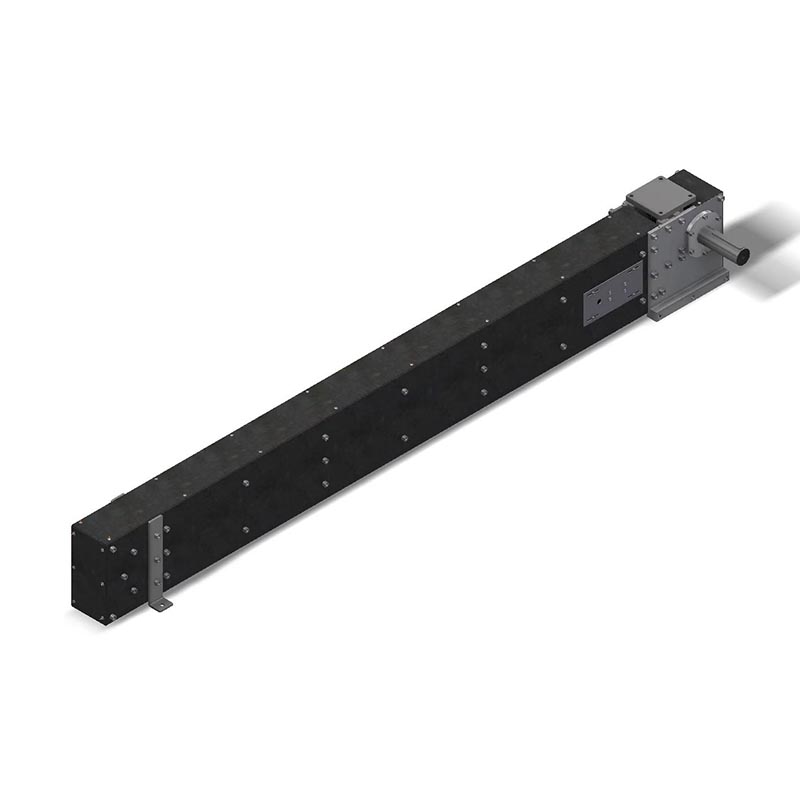
A rigid chain lift looks almost too simple from the outside: a motor, a gearbox, and a steel column. Inside that column, though, the chain isn’t being pulled like a rope or wound around a drum. Instead, individual links are fed edge-to-edge into a vertical guide channel, where they interlock to form a temporary solid column. This is the key difference from a standard hydraulic or screw lift — the chain only becomes rigid in one direction, while remaining flexible enough to be stored compactly in a magazine at the base.
As the drive sprocket pushes each link upward, the links are pressed against one another and against the guide rails. Small interlocking lugs or shoulders on each link prevent them from buckling forward under load. What you get is a push force transmitted through the chain, but with almost none of the sideways deflection you’d expect from a normal chain under compression. Because the links are not stretching or sliding against each other in the lifting section, the movement feels unusually smooth and quiet, with no jerky handoff between stages.
The return path is just as deliberate. Once a link reaches the top of the lift stroke, it leaves the rigid column and is guided down the back side of the track, often through a separate return channel or simply by gravity into the storage magazine. This continuous circulation means the lift can hold a load at any height without a brake holding the motor against back-driving — the interlocked links themselves carry the compressive load. That’s why rigid chain lifts are often chosen for applications where a clean, low-profile actuator is needed but traditional telescopic cylinders or ballscrews would be too bulky or too slow.
How a Flexible Chain Becomes a Locked, Load-Bearing Column
A loose chain flops and folds because each link keeps its own freedom to pivot. Push the two ends toward one another, and that freedom shrinks quickly. The links begin to stack against each other, their curved surfaces finding contact points that were never used while the chain hung slack. Small sideways shifts are no longer harmless; a link that starts to drift immediately presses into its neighbor, and that neighbor presses back. Without any single part being redesigned, the chain loses most of its ability to bend.
As the compression grows, the contact between links spreads from small points to broader patches. Friction rises, and the interlocking shape of each link starts to matter. A link that tries to slide out of line has to climb over the shoulder of the link below it, which demands more force than a lightly loaded chain can supply. At the same time, the load no longer travels through the chain as a wandering path; it runs straight down through the engaged faces of the links. That straight path is what turns a collection of loose rings into something that behaves like a solid column.
The lock-up is not caused by any link becoming rigid on its own. It comes from the chain closing down its own possible motions. With enough end pressure and enough lateral restraint along the height, even a slender chain can stand upright and carry weight that seems out of proportion to its flimsy appearance. The same principle shows up wherever flexible elements are packed tightly enough to block each other's movement, turning a soft assembly into a temporary but effective load path.
Custom Travel Lengths That Remove Dead Space and Extra Structure
Standard travel lengths often force a compromise: you choose the next size up, accept the unused stroke at the end, and build around the leftover housing. Custom travel lengths change that calculation. By matching the guide or actuator stroke to the actual movement envelope, the dead zone disappears, and the assembly stops carrying material that only exists to support a dimension nobody needed.
That removal of extra structure does more than save a few millimeters. It reduces end-of-travel overhang, simplifies mounting points, and keeps adjacent components from being pushed farther apart than necessary. The result is a tighter layout where every section of the rail or cylinder body corresponds to useful motion, not filler.
In retrofit work this matters even more. When an existing machine has fixed pickup and drop points, a custom length lets the new linear unit drop into the available space without reworking the frame around an arbitrary catalog increment. The motion path stays exactly as specified, and the hardware around it stays lean.
Holding Position Without Drift, Brakes, or Hydraulic Mess
Most positioning setups fall apart the moment the pump shuts off or a brake pad wears enough to lose bite. Loads creep, platforms sag, and the only answer used to be another valve, another accumulator, or a caliper that needs constant attention. That whole loop disappears when the drive train itself holds the load. A high-ratio worm gear or a precision ball screw with proper lead can sit under tension without needing external clamping, because back-driving force simply cannot overcome the internal friction and geometry.
The advantage shows up fastest in vertical axes and lift tables. Instead of balancing a cylinder against drift with counterbalance valves or fighting brake release timing, the actuator stops and stays. Power can be cut completely, and the load remains where it was left, minute after minute. There is no hiss of bypassing fluid, no puddle under the frame, and no delayed sag as pressure bleeds off through a fitting that was not quite tight.
Field service gets quieter too. Technicians no longer arrive with buckets, hoses, and spare seals for a drift complaint. The fix is usually a quick check of the drive nut, a firmware setting for holding torque, or a simple wear adjustment. That is a different kind of holding position: one that stays put without the supporting cast of hydraulics and friction brakes.
Maintenance Demands Compared With Screw and Hydraulic Lifts
Most maintenance teams find screw lifts easier to inspect at a glance because the wear surface sits right in the open. You are mainly looking for uneven play in the nut, greasing the screw, and occasionally checking alignment. There is no hidden oil condition to sample and no cylinder that can slowly drift when a seal ages.
Hydraulic lifts ask for a bit more housekeeping. Oil quality changes over time, especially in humid or dusty environments, so periodic fluid checks and filter replacements become routine. Seals and hoses can harden, and even a minor drip near the gland can signal that a repair should be scheduled before it turns into a bigger cleanup.
Neither system is uniquely fragile, but the maintenance is different in character. A screw lift rewards the discipline of lubrication and clearance inspections, while a hydraulic lift rewards clean oil, tight fittings, and watching for leaks. Facilities with limited in-house labor sometimes prefer the screw for its simpler checklist, while hydraulic systems remain perfectly manageable when the maintenance intervals are actually followed.
Where Rigid Chain Lifts Replace Bulkier Actuators Without Sacrificing Capacity
Rigid chain lifts earn their keep in places where a conventional screw or hydraulic actuator simply takes up too much room. The chain nests into a compact magazine when retracted, so the overall footprint stays shallow even when the stroke is long. Yet that space saving does not come at the cost of push or pull force. A well-built rigid chain column can move substantial loads vertically, often matching the capacity of far heavier cylinder-based systems while leaving more usable space around the work area.
What makes the swap practical is the way the chain locks into a solid column under load. In the extended position it behaves like a rigid post, resisting side forces and maintaining alignment without the gradual drift you might expect from flexible lifting media. This lets designers replace bulky telescoping actuators in stage lifts, material handling platforms, and assembly line stations without re-engineering the surrounding frame. The result is a cleaner layout, reduced installation time, and fewer clearance headaches under low ceilings or inside tight machine enclosures.
Maintenance also shifts in favor of the rigid chain approach. There are no exposed sliding rods that need constant lubrication, no seals that weep fluid, and no long cylinder body that must be housed below the floor. Most systems run with a simple motor and gearbox driving the chain sprocket, which keeps service intervals predictable and parts easy to reach. For engineers tired of trading lifting capacity for a smaller envelope, the rigid chain lift offers a middle path that preserves both.
FAQ
A rigid chain lift uses interlocking links that form a solid column when extended, so it can push loads upward rather than only pull. Standard chain hoists rely on flexible chain and a drum, which means they handle tension but not compressive force. That structural difference allows rigid chain systems to lift from below or fit into compact vertical spaces.
The chain is built so each link locks against the next as it leaves the storage magazine. Under load, the links align and brace against one another, creating a self-supporting column. When retracted, the links separate again and coil back into the magazine, so the stored chain takes up very little room.
Common custom options include stroke length, lifting speed, load capacity, mounting orientation, corrosion-resistant coatings, food-grade lubrication, and integration with specific controllers or sensors. Some builders also modify the chain material or add protective bellows for dusty or washdown environments.
It shines in applications with limited pit depth or tight vertical clearance, because the retracted chain stores compactly while still delivering a long stroke. It also avoids hydraulic fluid leaks, needs less routine upkeep than many hydraulic systems, and can handle frequent duty cycles without the temperature sensitivity of pneumatics.
Yes. Although vertical lifting is the most common, the same column-forming principle works horizontally or on an incline if the chain and guide system are designed for the side loads. Custom guidance and support rails are often added for those orientations.
They are often found in automated assembly lines, theater stage lifts, material handling platforms, cleanrooms, food processing equipment, and applications where a low-profile lifting mechanism must fit under a platform or inside a machine base. Anywhere a long vertical stroke must come from a compact housing, a rigid chain lift is worth evaluating.
Maintenance is usually modest. The chain and drive mechanism need periodic inspection and lubrication, and the guide blocks or bearings may need replacement after extended service. Because there is no hydraulic oil to change and no seals that routinely fail, downtime tends to be lower than with hydraulic systems.
Properly designed systems include holding brakes or self-locking gearing so the load stays in place when power is removed. The rigid column itself adds stability during lifting, but safety always depends on the specific design, load rating, and proper use of external locking or retention devices where required.
Conclusion
Inside a rigid chain lift, individual links arrive as a flexible chain but are guided through a storage magazine and into a lifting column where they interlock. Instead of relying on a long screw or a telescoping cylinder, the links form a locked, load-bearing column that pushes or holds a load along a straight path. Custom travel lengths make the design especially useful because the unused chain remains compact in a magazine, so there is no need to build extra structure around a fully extended actuator. Once the load reaches position, the locked links hold it without drift. There is no brake to adjust and no hydraulic pressure to maintain, which removes leaks, fading, and the usual mess tied to fluid power.
Compared with screw and hydraulic lifts, maintenance shrinks to inspecting the chain, guides, and drive components. There are fewer seals, hoses, and oil changes, and wear tends to be concentrated in predictable points rather than spread across a cylinder bore or ball screw. Rigid chain lifts also replace bulkier actuators in places such as machine tool changers, stage lifts, assembly stations, and material handling platforms where vertical stroke is long but floor space is tight. The result is a compact lifting system that keeps capacity while cutting the space, support steel, and upkeep required by conventional alternatives.
Contact Us
Contact Person: Ryan
Email: [email protected]
Tel/WhatsApp: +85259582726
Website: https://www.robomast.com/