

Large Industrial Fans Original Manufacturer Recommendations for High Performance Air Circulation
2026-11-18
Most industrial fans look the part, but few move air with the kind of authority a demanding workspace actually needs. If you've been sorting through catalog after catalog, only to find vague specs and recycled sales copy, you already know the problem: high-output circulation isn't just about blade diameter or motor wattage. It's about how the unit is engineered from the start, and whether the manufacturer will stand behind that design when conditions get tough. That's where original manufacturer recommendations change the conversation. Instead of guessing which large industrial fan can handle high ceilings, humidity, dust, or round-the-clock operation, you get direct guidance from the people who build them. VINDUSFAN has spent years refining that guidance for real facilities, not showroom floors. In this post, we'll break down what genuinely separates high-performance air circulation from ordinary airflow, and why where your fan comes from matters as much as how it's rated. If you're ready to stop compromising on coverage, efficiency, and longevity, keep reading.
Factory-Direct Large Industrial Fans Without the Rebranding Markup
The price tag on most large industrial fans doesn't reflect the cost of steel, motors, or assembly. It reflects the markup added at every step between the factory floor and your loading dock, especially when a well-known brand name gets stamped on the housing. Going factory-direct removes that layer entirely. You're buying the same oversized blades, the same gearbox, and the same powder-coated finish, but you're paying for the manufacturing and the freight, not the logo.
There's a common assumption that skipping the rebrand means sacrificing reliability or support. In practice, the opposite is often true. A factory that builds these fans for multiple labels knows exactly which components survive in hot, dusty, or humid environments. When you deal with them directly, you can specify blade pitch, motor phase, mounting height, and control options without a middleman filtering your requests. Spare parts come from the same production line, so lead times shrink instead of stretching across a distribution network.
For warehouses, gymnasiums, workshops, and agricultural buildings, the difference can amount to thousands of dollars per unit. That budget can go toward more fans, better installation, or a maintenance reserve. And because you're not locked into a reseller's catalog, you can order the exact diameter, airflow rating, and finish your space actually needs, rather than settling for whatever happens to be in stock at a regional distributor. Factory-direct isn't about buying a cheaper version; it's about cutting out the steps that add cost without adding value.
Why Blade Profile and Hub Assembly Matter Before You Compare Airflow Numbers
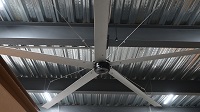
A fan that posts an impressive open-air CFM can quietly fall apart once it faces a grille, a filter, or a restrictive chassis. The blade profile is a large part of that difference. Two rotors can move the same volume in free air, yet one will shed far less flow as static pressure builds because the curvature, chord, and trailing edge shape keep the air attached rather than letting it spill back around the tips. If those details are ignored, the airflow number becomes a convenience rather than a meaningful comparison.
The hub assembly adds another layer that raw airflow tests rarely highlight. A smaller or more steeply tapered hub can open the intake area, but it also changes how air enters the blade root region and how much turbulence sits behind the motor. Assembly tolerances matter just as much: a slight misalignment or uneven blade spacing can create low-frequency noise and local stalls that do not show up in a simple CFM reading. Those flaws often become obvious only after installation.
Before stacking two airflow figures side by side, it is worth checking whether the blade and hub were designed for the same operating point. A high-flow blade that performs well with no back pressure may be the wrong choice for a dense radiator or ducted enclosure, while a steeper, lower-volume profile can deliver more useful air where resistance is already present. The number only tells part of the story; the shape behind it determines where that number survives.
Positioning Fans Around Racking, Mezzanines, and Production Lines for Fewer Dead Zones
Most facilities place high-volume fans in the middle of open floor space and then wonder why the areas behind racking or beneath mezzanines stay stagnant. The issue is rarely fan size or speed. It is geometry. Racking rows and mezzanine decks act as partial walls, so air needs a clear path that runs parallel to the aisle, not just a broad sweep across the room. Positioning units at the ends of long rack faces or just outside mezzanine openings lets the airflow follow the lane instead of slamming into a solid row of cartons.
On production lines, dead zones often form between equipment because heat rises off motors and gets trapped under conveyors or work platforms. A fan placed too far away only stirs the air above the line while the lower level stays hot. Angling a floor-mounted or column-mounted unit slightly downward and toward the line pushes cooler air beneath and around the equipment. Even small shifts—aiming the outlet past the edge of a mezzanine or between two tall rack sections—change how far the air travels before it breaks up.
Instead of treating coverage as a circle around the fan, it helps to think of aisles, mezzanine openings, and machine gaps as channels. Walk the space during a shift and note where heat, fumes, or humidity feel trapped. Then place fans to feed those channels, sometimes with overlapping paths so air does not stall at corners. Fewer dead zones usually come from deliberate placement near obstructions, not from adding more fans.
Motor Type, Torque, and Control Logic in High-Volume Air Circulation
The motor at the heart of a high-volume air circulator isn't selected for peak horsepower alone; it's chosen for how it behaves under sustained load. Brushless DC motors have become the default in better designs because they shed heat more efficiently and shrug off the dust that eventually chokes brushed alternatives. What matters in practice is torque curve flatness: a motor that delivers consistent rotational force across a wide RPM band keeps blade speed stable even as static pressure builds against filters or ducting. That stability is what separates a unit that merely spins air from one that pushes it through a packed room without sagging.
Control logic is where the real differentiation hides. Instead of simple triac-based speed dials that waste energy as heat, modern circulators use field-oriented control to adjust current angle in real time. This lets the motor respond to airflow resistance without audible hunting or torque ripple. Some firmware layers add a soft-start ramp that prevents the initial current spike from tripping breakers in older buildings, while others monitor back-EMF to detect blade imbalance before it becomes a bearing failure. The logic isn't just about speed steps; it's about keeping the impeller in its efficiency sweet spot across variable duct conditions.
A less obvious factor is thermal derating strategy. In a high-volume unit running 24/7, the motor's insulation class and the controller's temperature feedback loop decide longevity more than any spec sheet number. Good designs pull back current gradually as stator temperature climbs, trading a few CFM for years of added life. Cheaper units simply shut down or push through until the varnish breaks down. When you pair that with Hall sensor redundancy and a controller that tolerates brief phase loss, you get a circulator that can be forgotten in a ceiling plenum without becoming a service call.
Questions to Ask a Manufacturer About Airflow Testing and Real Facility Conditions
Most published airflow data comes from a clean, new filter on a controlled test stand, which rarely matches the way air actually moves around a crowded mechanical room or a process line that cycles on and off. Before accepting a performance curve, ask the manufacturer to describe the duct geometry, inlet conditions, and static pressure range used during testing, then compare that setup to your own facility drawings. If the test rig did not include bends, dampers, abrupt transitions, or real mounting brackets, the numbers may look better than what you will measure on site.
It is also worth pressing for details about what “real facility conditions” means in their test reports. A useful manufacturer should be able to tell you whether their airflow testing included particle loading over time, humidity swings, filter media compression, gasket aging, or vibration from nearby pumps and fans. Ask for a written description of preconditioning and any repeated test runs, not just a single clean-filter data point. That kind of detail reveals whether the unit was tested for the first hour of service or for the months after it actually gets dirty.
Finally, request evidence from installations that resemble yours in scale and operating pattern. Rather than asking for a generic case study, ask what happened when airflow dropped below design in a comparable facility, how they diagnosed it, and whether the manufacturer offered on-site verification or adjusted the control settings. A direct answer to that question tells you more than a polished specification sheet, because it shows how the manufacturer handles the gap between laboratory ratings and the uneven, imperfect conditions of a working building.
Spotting Build Quality in Noise Levels, Vibration, and Service Intervals
Build quality often reveals itself in the small, repetitive moments you might not think about until a long drive or a rough road. A door that closes with a low, solid thud instead of a tinny rattle, an engine that settles into a barely audible idle, or trim pieces that stay silent over expansion joints—these details accumulate into a clear picture of how carefully a vehicle was assembled.
Vibration is another telling signal. Pay attention to what you feel through the steering wheel, floor, and seat at highway speeds. A well-built machine tends to transmit a consistent, subdued hum rather than sharp, localized buzzes. If the shifter or pedals tingle at certain rpm, that often points to cost-cutting in isolation or mounting materials. Likewise, service intervals can be informative: unusually short oil or drivetrain service schedules sometimes reveal thermal stress or component wear that longer intervals might hide.
None of this should be read in isolation, but together these signals are far harder to fake than a premium badge. A vehicle that stays quiet, smooth, and predictable between services tends to reflect disciplined tolerances and better material choices.
FAQ
A genuine original manufacturer has in-house control over the motor, hub, blade geometry, and safety systems. That means the people you talk to can explain torque curves, thermal protection behavior, and mounting tolerances instead of reading from a generic cut sheet. You also get direct access to replacement parts without a middle layer guessing at compatibility.
Airfoil shape, blade count, and surface finish determine how much air moves at a given speed and how quietly it does it. A well-matched inverter-duty motor keeps torque steady across the speed range, so the fan does not struggle at lower RPMs or run hot during long summer shifts. Getting that pairing right matters more than chasing a single peak CFM number.
Raw CFM tells you how much air leaves the fan, but not where it goes. In large spaces, the most useful flow is a broad floor-level pattern that reaches work zones, loading bays, and mezzanines without dead spots. A well-designed large industrial fan pushes air outward and down in a stable column, which improves cooling and destratification even when the rated CFM looks average on paper.
Ceiling height, column placement, skylights, overhead cranes, storage racks, and existing ventilation all change the answer. A proper recommendation considers mounting clearance, sidewall obstructions, and whether the fan will run alone or with exhaust systems. Measuring those details first prevents installing a fan that looks right in a brochure but fights the building layout.
Direct sourcing keeps the engineering and support path short. When a motor controller fault occurs or a blade needs replacement after years of service, the original manufacturer can identify the exact revision and provide the correct part quickly. You also avoid the risk of unauthorized substitutions that may fit loosely and shorten component life.
Routine checks on blade torque, safety cable tension, motor cooling fins, and control panel connections catch small problems before they become shutdowns. In dusty or humid plants, cleaning blade surfaces and inspecting bearings on a schedule prevents imbalance and unnecessary wear. Logging vibration and amp draw during inspections gives you an early warning for bearing or alignment issues.
Air distribution follows the building shape. A single oversized fan can create strong drafts near the center while leaving aisles and perimeter work areas untouched. Multiple correctly placed units overlap their airflow patterns and maintain gentle, even motion across the entire floor, which is usually more comfortable and more efficient for cooling people and processes.
Ask for performance data from a similar building, not just a warehouse with ideal conditions. Request details on motor efficiency, inverter compatibility, balancing tolerances, and emergency stop design. Also ask how the fan behaves at part load, because most industrial facilities run fans at reduced speed for many hours. If the supplier cannot explain those points clearly, the recommendation is not fully engineered.
Conclusion
Buying a large industrial fan directly from the original manufacturer changes what you can actually verify before purchase. You are not paying for a rebranded label, so the conversation can focus on the parts that determine long-term performance in a busy facility. Blade profile and hub assembly deserve more attention than a single airflow rating because two fans with similar published numbers can behave very differently around tall racking or under a mezzanine. A factory engineer should be able to explain why the blade shape was chosen, how the hub holds the blades under load, and where the fan should be placed relative to production lines to avoid dead zones. Those details often matter more than the highest cubic-feet-per-minute figure on a brochure.
Motor selection and control logic are equally important when the fan runs across shifts. The right torque characteristics keep the blades moving smoothly without stressing the drive system, while staged or variable control makes it easier to match airflow to changing work conditions. Ask for test data that reflects your actual ceiling height, obstructions, and heat sources instead of an open-room number. A well-built unit will usually reveal itself through low vibration, consistent noise behavior, and realistic service intervals rather than marketing claims. If the manufacturer hesitates on questions about bearing loads, balancing procedures, or airflow testing protocols, that hesitation tells you more than a polished specification sheet.
Contact Us
Contact Person: Michael Danielsson
Email: [email protected]
Tel/WhatsApp: +1 951 565 7769
Website: https://www.vindusfans.com