
Substantial Artificial Flowers That Look Stunning in Any Space
2026-10-22
Some rooms just feel finished. Others hover in that awkward in-between—too bare to be minimal, too busy to be cozy. A few well-chosen stems can tip the balance, and not just any stems: the substantial kind that hold their shape, keep their color, and never droop by day three. That’s where PHLEEYA comes in. Their oversized artificial blooms don’t whisper from a corner; they anchor it. From entryway statements to dining-table centerpieces, these pieces prove faux can be bold, believable, and built for real life. Here’s how to make them work in your space.
When a Single Oversized Stem Outshines a Whole Bouquet
There’s a quiet drama in placing one enormous stem in an empty vase. Not the polite cluster of mixed blooms, but a single protea the size of a dinner plate, or a branch of quince with blossoms like dropped silk. The eye has nowhere to wander, so it settles, and the room seems to exhale. Scale does the work that abundance usually tries to do—only with more confidence.
A bouquet asks for arrangement, for balancing colors and heights, for the nervous fiddling of stems until they sit just so. A single oversized stem asks only to be placed. Put a massive sunflower in a narrow-necked bottle and watch how the whole table shifts. The flower becomes less a decoration and more an object you notice from across the room. That kind of presence is hard to get from twenty smaller blooms all vying for attention.
There’s also the practical charm: no wrestling with floral foam, no guilt when one stem wilts faster than the rest. You buy less, you fuss less, and somehow the room feels more deliberate. If you need proof, try a single stem of dried palm or a fresh king protea in a plain glass cylinder. Leave it alone. See how long it takes before someone asks where you got it.
Materials That Mimic Petal Veins and Morning Dew
The vein network in a rose petal isn't just structural—it creates a subtle topography that pins water droplets in place while the surrounding tissue stays waxy and water-repellent. Researchers have borrowed this pairing by casting soft polymers like PDMS onto laser-cut or photolithographic vein patterns, then treating only the raised veins with a hydrophilic plasma. The result is a surface where dew condenses preferentially along the vein lines, forming bead-like droplets that don't roll off even when tilted. This reproduces the petal's dual wetting behavior, where adhesion and repellency coexist at different scales.
Going further, some groups use 3D-printed vein-like channels filled with hygroscopic hydrogels to actually pull moisture from humid air. When morning dew would normally form as scattered droplets, these synthetic veins collect the water into continuous rivulets and direct it toward a reservoir, mimicking how a leaf funnels dew toward its stem. Other versions embed silver nanowires in the vein pattern to heat the surface slightly, causing dew to evaporate in a controlled way and leave behind a clean, anti-fogging finish. The key isn't just copying the shape—it's reproducing the wetting contrast between vein and surrounding material.
Placing Large Faux Arrangements Where Fresh Flowers Struggle
Fresh flowers have their limits, and anyone who has tried to keep a centerpiece alive in a dim hallway or a sun-blasted windowsill knows exactly where those limits live. Instead of fighting the environment, work with it by placing a well-crafted faux arrangement in spots that would normally wilt a real bouquet within days. Think entryways with no natural light, bathrooms with high humidity, or that awkward corner above the radiator where nothing green has ever survived. A large artificial arrangement can anchor these spaces without demanding a single drop of water or a change of vase water.
The trick is to match the scale and style of the faux piece to the room's existing character, so it reads as intentional rather than as a placeholder. A tall, loose cluster of faux eucalyptus and white lilies can soften a windowless powder room, while a dense arrangement of artificial hydrangeas in a wide ceramic pot brings life to a covered porch that gets only reflected light. Because these arrangements don't rely on photosynthesis, you can position them where a living plant would simply give up—like directly under an air vent or on a high shelf that's impossible to reach for regular watering.
To keep large faux arrangements from looking like an afterthought, vary the heights and textures within the piece, and occasionally dust the leaves with a dry microfiber cloth. Swap out a few stems seasonally—add dried grasses in autumn, white berries in winter—so the display evolves without the maintenance of a living plant. This approach lets you bring the visual weight of greenery into the exact spots where fresh flowers struggle, turning a practical limitation into a deliberate design choice.
Mixing Oversized Blooms With Dried Grasses and Branches
There’s a particular tension that happens when a blowsy garden rose or a dinner-plate dahlia shares space with brittle oat stems and a twisted branch. The living, almost fleshy quality of the big bloom rubs against the parchment-like dryness of the grass, and that friction keeps the eye moving. Rather than fighting for dominance, the dried material gives the flowers a rough scaffolding to lean into, so the arrangement starts to feel more like a found landscape than a formal centerpiece.
Scale matters more than variety here. One or two oversized focal flowers — peonies, king protea, large mums — usually carry more weight than a half dozen mid-size blooms. Tuck dried grasses like phalaris, pampas, or bunny tails behind and between them at uneven heights, and let a few bare branches extend past the silhouette. The stems don’t have to be symmetrical; a branch jutting slightly left while a heavy bloom drops right creates a sense of motion without making the piece look unstudied.
Working with dried elements also buys you time. The grasses and branches won’t wilt, so you can play with placement for as long as you like, and the arrangement ages into something quieter as the fresh blooms fade. If you’re cutting from the garden, dry the grasses first so their stems don’t droop in the vase. A heavy ceramic or stoneware container helps anchor the whole thing, especially when the branches are long enough to shift the center of gravity.
Color Palettes That Keep Big Floral Statements From Overpowering
Large-scale floral patterns bring drama, but they can easily dominate a room. The trick is to anchor them with colors that share the same undertone. If the flowers lean warm—think coral, amber, or golden yellow—surround them with soft creams, warm taupes, or muted terracotta. These hues pull from the bloom itself, so the pattern feels integrated rather than loud.
For cooler palettes, where blues, lavenders, and greens dominate the print, choose walls and upholstery in dusty grey, pale sage, or washed indigo. This keeps the floral as the focal point without letting it shout. A common mistake is pairing a bold floral with stark white or pure black, which can heighten contrast and make the pattern feel jarring. Instead, go for ivory, charcoal with a blue cast, or even a soft blush that echoes a petal tone.
Another approach is to repeat one accent color from the floral in solid textiles—a throw pillow, a rug border, or a lampshade. That single repeated hue gives the eye a resting place. When every other element stays quiet, the floral reads as intentional art rather than visual noise.
Cleaning and Storing Substantial Stems Without Losing Shape
Cleaning thick, wired stems asks for a lighter touch than most people expect. Instead of dunking the whole stem in water, wipe it down section by section with a barely damp cloth, working from the base upward. For stubborn grime near leaf joins, a soft-bristled toothbrush dipped in mild soapy water gets into crevices without bending the wire or cracking any coating. Let each stem air-dry completely on a flat towel before you even think about packing it away.
Once they're clean, storage is where shape gets lost. Never toss substantial stems into a box where they'll be pressed flat. Roll them loosely in acid-free tissue paper and stand them upright in a tall bin, or lay them in a single layer with crumpled paper supporting the curves. If a stem has a deliberate bend or arch, trace that line on kraft paper and use it as a guide when wrapping, so the original silhouette stays put.
For extra insurance, avoid plastic bags entirely—trapped moisture softens stems and invites mildew. A breathable cotton sleeve or open-ended paper wrap lets air circulate while keeping dust off. Check stored stems once a season, and if any have shifted, reshape them gently by hand rather than forcing them back with heat or water.
FAQ
Oversized silk peonies with soft, irregular petal edges, giant faux monstera stems, and cherry blossom branches with realistic bark texture tend to read as intentional rather than plastic. Look for blooms with color variation, not a flat spray-painted finish.
Give them a dedicated focal point instead of scattering small stems. A single dramatic branch in a heavy ceramic or stoneware vase works better than trying to fill a shelf with too many pieces. Bend the stems and arrange them at different heights so nothing sits in a stiff, symmetrical line.
Go for weighted, low-profile containers like a wide cylinder or a rounded urn. Tall, skinny vases tip over easily under the weight of substantial stems. A vase with a matte or textured surface also helps distract from the fact that the flowers are not real.
Yes, if you scale back the quantity. One or two oversized stems in a narrow entryway or on a bathroom vanity can add height without eating floor space. Stick to a monochromatic palette or vary shades of the same color so the arrangement stays airy.
Use a hair dryer on the cool setting to blow off dust, or rinse silk flowers in lukewarm water with a drop of mild soap. For textured petals and leaves, a soft paintbrush gets into crevices without snapping delicate parts. Avoid direct sunlight to prevent fading.
Faux pampas grass, magnolia branches, and orchid stems tend to age well because their real counterparts already have a slightly stiff or dried look. Skip ultra-fragile varieties like faux baby's breath or thin-stemmed wildflowers unless you are prepared for shedding and bent tips.
Position them where eyes land first: on a console table near the entry, at the end of a hallway, or on a dining table as a low centerpiece. In rooms with high ceilings, go taller with a statement branch. In low-traffic corners, oversized blooms can brighten an otherwise ignored space.
Conclusion
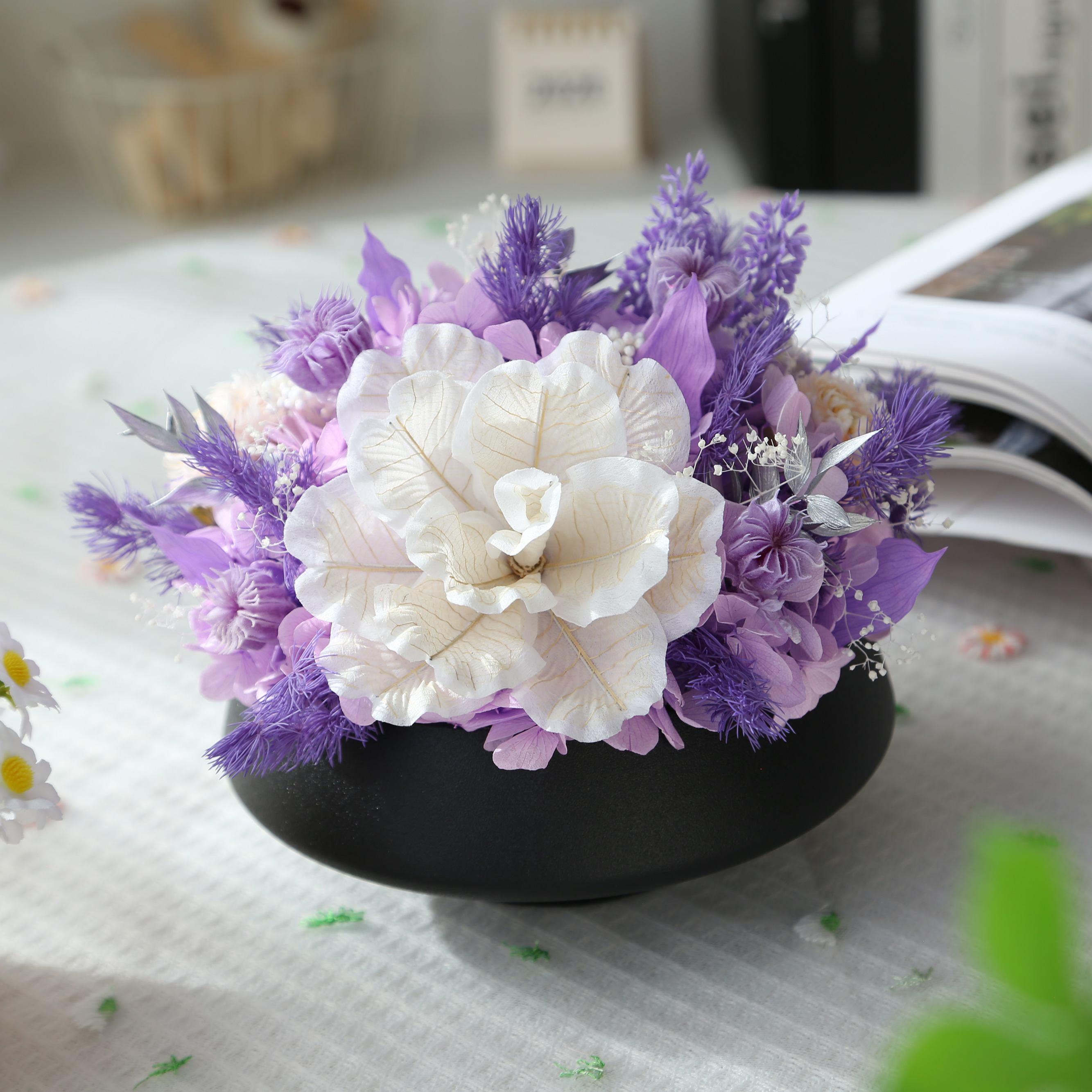
There's a reason a single oversized stem can outshine an entire mixed bouquet. It draws the eye immediately, creating a focal point without visual clutter. High-quality substantial faux flowers now include textured petals with visible veins and a subtle gloss that reads as morning dew, so they don't demand distance to look convincing. Because they tolerate low light, dry air, and temperature swings, they work beautifully in entryways, bathrooms, or bright conservatories where real blooms would wilt within hours. This reliability lets you decorate spaces that usually sit empty or rely on purely sculptural objects.
To keep these large arrangements from feeling heavy, mix the blooms with dried grasses, pampas, or bare branches. The contrast between soft petals and brittle stems adds depth and makes the whole display feel gathered rather than manufactured. Color also matters. Choose two or three closely related tones, such as blush, oat, and deep green, and avoid too many competing brights. For upkeep, dust each bloom with a soft brush or use a cool hair dryer on low. If a petal bends, a few seconds of steam will help it recover. Store upright in a tall container or wrap in tissue inside a box to preserve the shape until next season.
Contact Us
Contact Person: Mr. Luo
Email: [email protected]
Tel/WhatsApp: 86 18100895505
Website: https://www.feiliyaflowers.com/en/