

Top Roto Moulding Machine Features That Improve Production Quality
2026-11-20
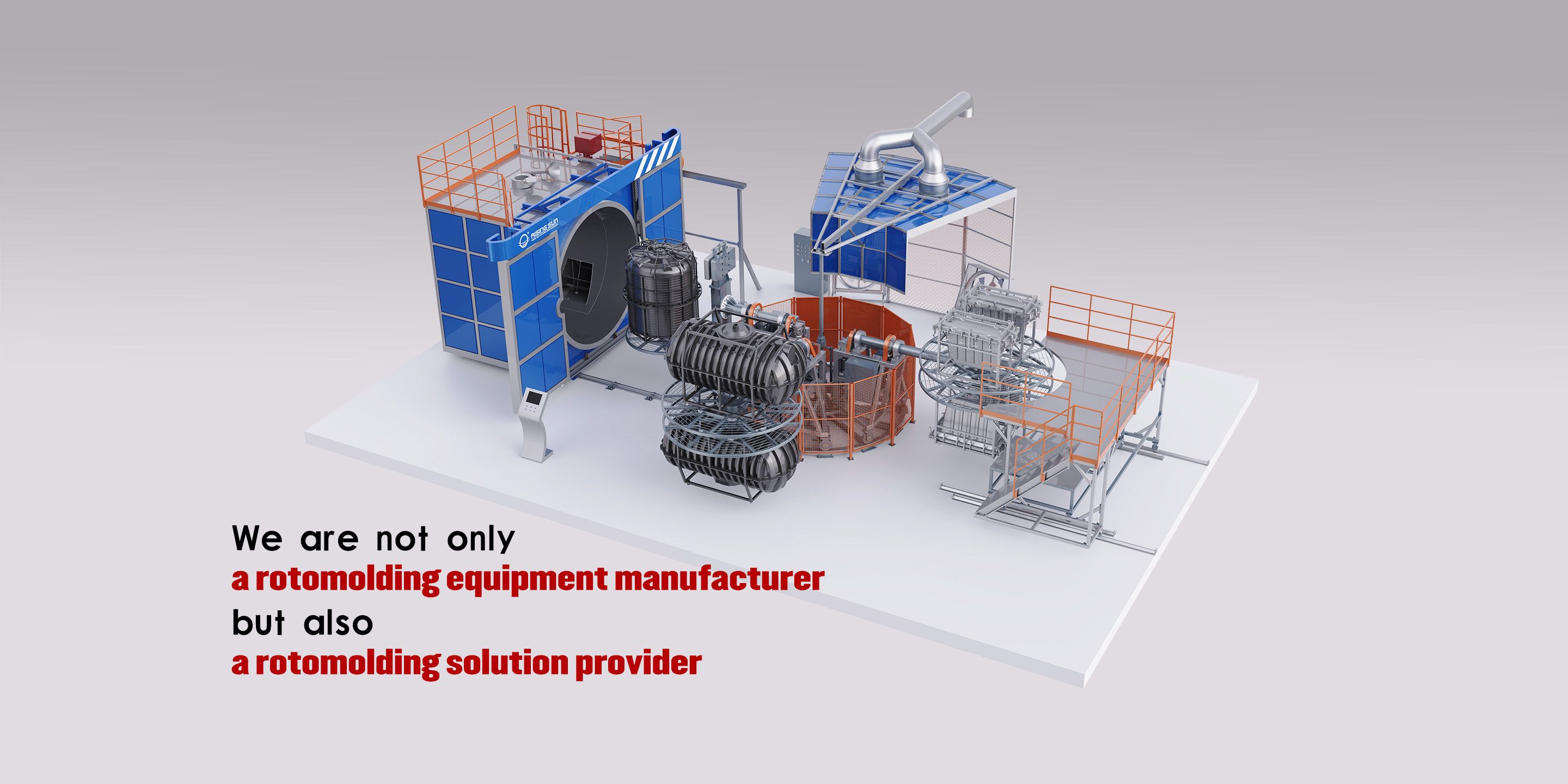
In rotational molding, the machine you choose has a direct impact on part consistency, wall thickness control, and overall production efficiency. Many manufacturers overlook subtle design differences that separate average output from high-quality finished products. This article breaks down the key roto moulding machine features that genuinely improve production quality—covering everything from multi-axis movement to precise temperature control. For molders looking to reduce defects and increase throughput, understanding these details is essential. At Rising Sun, we focus on engineering improvements that address real production floor challenges rather than adding unnecessary complexity. Read on to see which features make a measurable difference in your daily operations.
Multi-Axis Rotation That Keeps Wall Thickness Even in Tight Corners
Most rotary tools struggle when paths get narrow or bend sharply, but this head moves through those zones without letting wall thickness drift. The trick is in how the rotation axes overlap their ranges, so the nozzle can lean into a corner and still deposit material at a consistent offset from the inner surface. You notice it most where two walls nearly meet, the kind of geometry that usually forces a slowdown or a thin spot.
Instead of treating tilt as a separate correction step, the system ties it directly to the toolpath curvature. As the direction changes, the head shifts its angle just enough to keep the outer and inner boundaries parallel. That means the programmed wall dimension survives the whole pass, not just the straight sections. Tight radii, tapered slots, deep pockets with undercut edges, none of them demand a manual rework or a drop in layer quality.
What used to be a headache on long parts with hidden interior corners is now handled in one continuous motion. The material lands where it should, the wall stays strong, and the finished surface doesn't show the usual signs of dwell or overcorrection. It feels less like compensating for a machine limit and more like the head simply knows how to hug the geometry.
Oven Airflow Design That Removes Hot and Cold Zones
Most ovens struggle because heat rises and gathers at the top, leaving the lower rack noticeably cooler and the door side even worse. This design tackles that by pulling air through a rear intake and pushing it back through multiple vents along the back and side walls rather than relying on a single fan blast. The result is a steady sideways and downward sweep that keeps the temperature more even across the whole cavity.
The fan itself runs at a lower, wider curve instead of spinning hard in one spot. Curved deflectors and staggered vent openings break up the airflow so it reaches the front corners and under the racks, which are usually the coldest spots. Because the air keeps moving without blasting directly at the food, delicate items like soufflés and meringues bake evenly without drying out on the surface.
There is also a feedback loop between the thermostat and the fan speed. When you open the door, the system senses the drop and briefly increases circulation to recover the lost heat, then settles back to normal. This means you can bake on two or three racks at once and get the same browning without rotating trays halfway through.
Mold Changeover Speed Without Disturbing Quality Settings
Fast mold changes usually come with a quiet assumption that somebody will have to re-tune the process afterward. It does not have to work that way. The trick is to treat the mechanical side of a changeover and the process recipe as separate layers. Clamping, alignment, water connections, and knockout setup can be streamlined aggressively, while the proven injection profile, temperatures, and cushion settings stay locked. Once operators stop adjusting both layers at the same time, most of the quality drift disappears.
A practical approach is to move as much setup detail as possible into the mold itself or the machine recipe. Quick-release clamps, guided locating rings, and pre-coupled manifold connections remove minutes without touching any parameter. When the mold arrives at the press, the controller pulls up the last validated recipe automatically. The operator verifies mechanical engagement, checks that ejector strokes move freely, and starts. No manual entry, no small tweaks from memory.
The first shots after a changeover then become a confirmation step rather than a correction step. If the part shows a short shot, flash, or sink, the response should be to inspect the installation, nozzle contact, or material feed, not to chase the problem by altering the saved process. Keeping the quality settings untouched gives you a stable baseline, which makes actual mechanical issues much easier to spot and fix.
Cooling Cycles Tuned to the Polymer Instead of a Fixed Timer
A fixed timer treats every resin as if it sheds heat at the same rate, which rarely matches what is happening inside the mold. Amorphous and semi-crystalline materials leave the cooling stage on very different terms: one may need time for molecular relaxation, the other for crystal growth before ejection. When the cycle is locked to a clock instead of the polymer's actual condition, the machine either waits longer than necessary or opens while the part is still soft at the core.
Shifting the endpoint to the polymer means reading the material's own signals—cavity pressure decay, mold surface temperature, or a calculated solidification front—rather than counting seconds. A thin-walled polypropylene lid and a thick polycarbonate housing can then receive separate cooling windows even if they run on the same press. The timer becomes a fallback, not the rule, and the controller releases the part only after the melt has reached a stable ejection state for that specific grade.
This approach tends to shorten cycles on commodity parts while preventing warpage, sink marks, or ejection damage on more demanding ones. It also makes startups and material changes less dependent on trial runs, since the cooling logic follows the resin's thermal behavior instead of a conservative setting inherited from an unrelated job. The result is a process that behaves more like an observer of the polymer and less like a kitchen timer.
Material Feed Monitoring That Prevents Contamination at the Source
Contamination rarely announces itself with a visible spill or an obvious leak. More often, it starts quietly: a worn seal on a feed line, a poorly seated connector, or residue left behind after a routine batch change. Monitoring the feed itself, right at the point where raw material enters the process, shifts the focus from cleaning up problems to never letting them take hold. Instead of relying on downstream sampling that catches trouble after the fact, inline sensors and pressure differentials can flag subtle shifts in flow, moisture, or particulate load before they become a quality issue.
The real advantage comes from treating the feed point as a controlled boundary rather than a passive opening. Temperature spikes, unusual vibration, or a gradual drift in material density all tell a story long before a contaminant reaches the finished product. By tracking these signals continuously, operators can distinguish normal variation from genuine risk, adjusting valves, swapping filters, or tightening connections while there is still time. This kind of early intervention prevents cross-contamination between batches, reduces scrap, and keeps the entire line running without the stop-start rhythm of reactive maintenance.
Practical implementation does not require a complete overhaul. Retrofitting existing hoppers, conveyors, and feed throats with simple optical or capacitive probes often delivers immediate visibility. The key is positioning the monitoring close enough to the source that it catches contamination while it is still local, not after it has dispersed through a mixer or reactor. When every operator can see the feed condition in real time, the conversation changes from "where did this batch go wrong?" to "what can we adjust before the next one does?"
Live Process Data That Flags Drift Before Rejects Pile Up
On a molding line, the thermocouple data streaming from each cavity rarely looks alarming at first glance. The real value is in the trend. A shift of half a degree in melt temperature or a slight drop in hold pressure may stay inside specification for a while, but it shows up clearly against the baseline. When the live process view compares every cycle to that learned baseline, the system can flag the drift while the parts are still good.
That early flag changes the conversation on the floor. Instead of discovering a bad run at final inspection and quarantining bins of finished product, a technician gets a narrow alert: pack pressure on cavity 4 is trending low. The adjustment happens at the machine, in the moment, before variation turns into dimensional rejects.
The result is less scrap and fewer surprise stoppages. It also builds a clearer picture of which process variables actually matter, because the system keeps tying small deviations to downstream quality outcomes rather than waiting for a hard limit to be crossed.
FAQ
Closed-loop control of speed and temperature makes the largest difference. When each arm moves at the same rate through every cycle and heat is held within a narrow band, the powder melts and coats the mould more evenly. Machines with independently driven axes tend to produce fewer thin spots than those relying on a single drive train.
A true multi-axis setup lets the mould tumble through a wider range of positions, so material reaches corners, ribs, and undercuts instead of pooling along flat sections. The quality gain is most visible on complex parts where single-axis rotation would leave voids or excessively thick rims.
The resin needs to reach full fusion without degrading near the mould surface. If the oven runs too cool, the inner wall stays powdery or weak. If it runs too hot, the outer layer can oxidize and become brittle. Precise control keeps the melt in the right window longer, which translates into stronger walls and fewer cosmetic defects.
Consistent clamping force stops the parting line from shifting or flashing during heating and cooling. It also prevents the two mould halves from loosening as metal expands, which can cause dimensional drift. Reliable clamps mean less trimming, fewer rejected parts, and more repeatable wall sections.
They handle repeatability better than manual adjustments, especially across shift changes. A stored recipe for air temperature, cycle time, and rotation speed removes guesswork. Operators still matter for loading, material handling, and spotting issues, but automated controls sharply reduce variation from one run to the next.
Guarded movement zones and monitored cooling cycles help in ways that go beyond safety. For example, a slow controlled opening after cooling prevents warping caused by sudden temperature shock. Interlocked doors stop operators from opening a hot mould too early, which protects both people and the dimensional stability of the part.
Forced-air and infrared systems transfer heat more evenly into deep mould cavities. Because heat reaches the powder faster, ovens can run at slightly lower temperatures for shorter periods and still achieve full fusion. The result is a shorter cycle with a more uniform crystalline structure, not just a rushed part.
Conclusion
Modern roto moulding lines earn their keep in the details that are easy to overlook until scrap rates climb. A true multi-axis arm movement does more than spin the tool; it forces the melt into deep ribs and tight corners, keeping wall thickness consistent where thinner sections usually appear. Pair that with an oven airflow pattern designed to break up hot and cold pockets, and the part cures evenly no matter where it sits in the chamber. Quick mold changeover also matters more than many shops expect. The best systems swap tools without resetting air flows, temperatures, or rotation speeds, so the next job starts with the same proven parameters instead of a fresh round of trial shots.
Quality also depends on how the machine handles cooling and raw material. Cooling cycles linked to the polymer’s actual behaviour, rather than a generic timer, let crystalline and amorphous materials stabilise at their own pace, cutting warpage and sink marks. At the feed stage, closed or monitored loading keeps fines, moisture, and foreign particles from entering the process before they can weaken the finished product. Meanwhile, live process data from pressure, temperature, and drive sensors flags small shifts early, allowing adjustments while parts are still in tolerance. Taken together, these features turn the machine from a simple oven-and-arm setup into a controlled production tool that holds quality run after run.
Contact Us
Contact Person: Sharon Zhu
Email: [email protected]
Tel/WhatsApp: 8615712666272
Website: https://www.risingsunroto.com