

Vehicle Ozone Machines You Should Consider for Cleaner Car Air
2026-11-17
A lingering smell of fast food, damp carpet, or pet dander can turn even the newest car into a place you’d rather not be. Air fresheners only mask the problem, while bacteria and odors keep circulating through the vents. That’s where vehicle ozone machines step in—they don’t just cover up cabin air issues, they neutralize them at the source. In this guide, we’ve rounded up the models worth your attention, including dependable options from LUFUTATECH, so you can breathe easier on every drive.
Why a Vehicle Ozone Machine Works Better Than Masking Odors
Most sprays and vent clips don't remove the problem; they just layer a stronger scent over the original one. A vehicle ozone machine takes a different route by releasing O3 into the cabin, where it reacts with odor-causing compounds and breaks them apart. That means the smell isn't hidden behind perfume—it's actually gone by the time the treatment finishes.
Masking products fade quickly because the underlying source stays intact. Spilled milk in carpet padding, smoke trapped in headliner fabric, or moisture that led to mildew will keep releasing odors as the cabin heats up. Ozone reaches into those same tight spaces and oxidizes the organic material responsible for the smell, which is why results tend to last longer than a temporary air freshener.
There is also no lingering chemical perfume to deal with afterward. After a proper ozone treatment and airing out, the interior smells neutral rather than like a rental car soaked in synthetic fragrance. For people with sensitivities or anyone trying to sell a car, that neutral result often matters more than a short-lived cover-up.
Matching Ozone Output to Your Cabin Size Without Overpaying
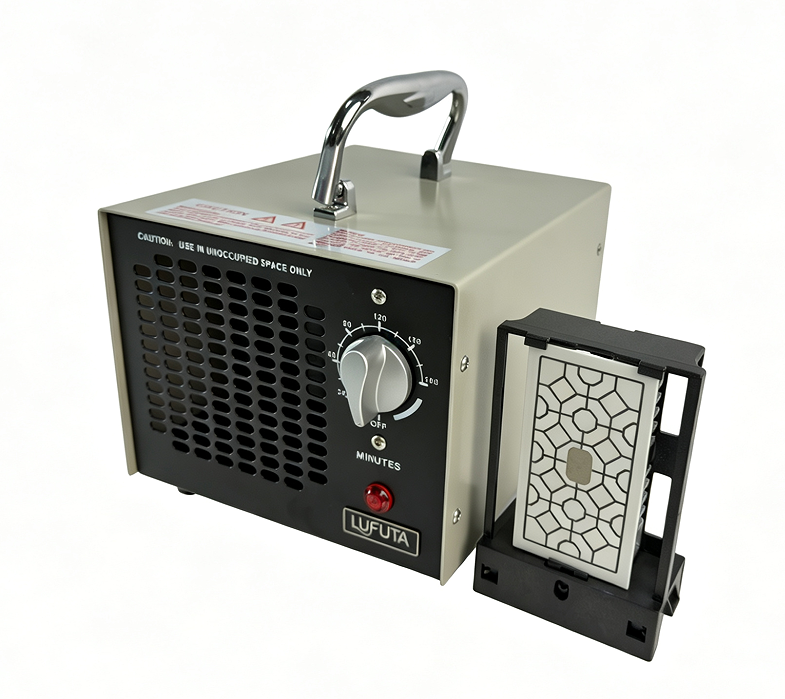
Cabin size, not brand specs, should drive the output number you choose. A compact 10 by 12 foot room with standard ceilings holds roughly 960 cubic feet of air, while an open 20 by 30 foot space holds several times that. If you buy a unit rated for 10,000 mg/hr to treat the smaller room, you are not getting faster results; you are just running a machine far beyond the space it needs to treat and paying extra for capacity that never gets used well.
Start with the volume of the space, length times width times height, and match the ozone output to that volume rather than to marketing labels. For most enclosed cabins between 300 and 600 square feet, a unit in the 3,000 to 6,000 mg/hr range is usually sufficient for odor removal. Reserve higher output for large open areas, heavy smoke damage, or short treatment windows. An adjustable dial helps more than a big peak number because you can dial down for a small bedroom and turn it up only when a larger area needs work.
One more thing that prevents overspending is checking the continuous output, not just the peak figure printed on the box. Peak numbers can make a low-output machine look stronger than it is, and that is exactly how people end up overpaying for undersized or oversized gear. Figure out your cabin volume, pick a unit that can handle at least that volume within your available treatment time, and stop there. Most buyers will never need the top of the range.
Timer Settings That Protect Leather, Vinyl, and Wiring
Leather and vinyl do not handle sustained heat the way paint does. A timer that runs too long turns a safe warming pass into a slow cure for shrinking, hardening, or lifting seams. Keep first passes under eight minutes, then let the surface breathe for five before returning. The rest gap matters just as much as the heat interval, especially on older interiors where the finish is already thin.
Wiring is even less forgiving. Harness wraps, connectors, and adhesive-lined loom can soften quickly when heat lingers near door panels or under dash edges. A repeating five to six minute cycle with a three to four minute rest works better than one long soak, particularly around airbag connectors and factory tape.
If you are working in direct sun or a hot bay, shorten those intervals by a third. Check surface temperature by hand often, and never leave a timed cycle unattended just because the alarm is set.
The Placement Trick for Reaching Vents and Headliners
Slide the seat all the way back and tilt the backrest until it nearly touches the rear cushion. This creates a flat bridge from the door sill to the center console, so you can brace your hip against the seat edge instead of twisting your spine. Keep the tool hand above your shoulder line when aiming at the vent blades; that angle lets the brush tip catch the inner louvers without pushing debris deeper.
For the headliner, stand outside and lean diagonally across the seat with your weight on the door frame, not the upholstery. Move the cloth in short, straight passes along the grain, stopping just before the edge near the grab handle. Repeating this from the opposite door shifts the light across the fabric and shows the smudges that front-on work always misses.
How Long to Run a Cycle for Smoke, Pet, or Food Odors
The length of an ozone treatment depends on how deeply an odor has settled into the space. A light food smell from last night's dinner might clear up in as little as thirty minutes, while a stubborn pet accident or cigarette residue can take several hours. Rather than guessing, start with a shorter cycle and check the room afterward—you can always run it again if a faint trace remains.
For smoke odors that have soaked into walls, upholstery, or carpet fibers, expect to run the machine for two to six hours in a sealed room. Pet odors trapped in subflooring or furniture padding often need a similar window. Food smells are usually the easiest to tackle, especially if you treat the kitchen or dining area soon after cooking. Keep in mind that high humidity and porous materials will slow things down, so give the ozone extra time to work in those conditions.
A practical approach is to treat the room in blocks of one to two hours, then ventilate thoroughly and reassess. This prevents overexposure and lets you gauge whether the smell is gone or just masked. If you are dealing with a car interior, a small closet, or a single piece of furniture, thirty to ninety minutes is often enough. The goal is to match the cycle length to the severity of the odor, not to simply run the machine on a fixed timer.
Ventilating and Cleaning After the Ozone Treatment Ends
Once the ozone generator has finished its cycle and the space has been closed up for the recommended dwell time, the first step is to get fresh air moving. Open windows and exterior doors on opposite sides of the room so air can cross through. Place a box fan near an opening if natural airflow is weak. Ozone breaks down faster when it has somewhere to go, and lingering concentrations can irritate the lungs, so give the area at least thirty to sixty minutes of active venting before anyone spends time inside.
After the air no longer carries that sharp, bleach-like odor, go over hard surfaces with a damp microfiber cloth. Ozone can react with dust, residues, and certain plastics, leaving a fine film or a faint odor on countertops, tables, and shelving. Wipe from top to bottom and rinse the cloth often. For fabric-covered items, run a vacuum with a clean filter across sofas, mattresses, and curtains to pick up settled particles. If a closet or cabinet was treated, leave its doors open during this cleanup so trapped air can escape.
Don't rush to seal the room again. Keep ventilation going for a few hours while you wipe down switch plates, handles, and other frequently touched spots. If the space still smells like ozone or feels stale after two air exchanges, extend the venting and re-check the treated area. A final pass with a mild, unscented cleaner can remove any leftover residue without replacing the treated air with heavy perfumes.
FAQ
It releases ozone, which reacts with odor molecules and breaks them down rather than just covering them up. The gas gets into vents, fabric, and little gaps where smoke or food smells tend to hide, so the result is closer to neutralizing the source instead of masking it.
No, you should stay out of the vehicle during the treatment. Ozone is an irritant for your lungs, so the usual approach is to run the machine with the doors and windows closed, then air the car out thoroughly before you drive it again.
Most people find 20 to 40 minutes is enough for mild odors, while heavy smoke or pet smells may need an hour or two. After the cycle, leave the doors open for a while because the ozone needs time to dissipate and convert back to normal oxygen.
Occasional use is generally fine for most hard surfaces, but repeated long exposures can dry out rubber, vinyl, and certain plastics over time. If you treat your car often, keep the sessions short and condition leather or vinyl afterward to reduce the risk of cracking.
It can make a major difference, especially on surfaces the gas can reach. However, if tar and smoke residue are deep in the headliner or seat foam, you may need several treatments plus a thorough interior cleaning for the smell to truly go away.
Focus on a compact unit that runs on 12V or has a portable power option, with an output that is not overkill for a small cabin. A timer is useful too, because you do not want to run it too long and then have to wait ages before the car is breathable again.
For routine upkeep, a few times a year is plenty. If you are dealing with a specific spill, wet dog smell, or smoke, treat the car as needed, but do not make heavy ozone use a weekly habit unless you are also keeping up with regular cleaning and ventilation.
Yes, they can knock down the musty odor and help with surface spores in the cabin, but they will not fix the underlying moisture problem. You still need to find and repair the leak or damp area, otherwise the smell will come back.
Conclusion
Ozone generators earn their place in a car care kit because they attack the source of stale air instead of covering it with fragrance. Matching the machine's output to the cabin size matters more than chasing the highest milligram-per-hour number; a compact sedan usually needs far less than a three-row SUV, and overspending on excess capacity rarely improves results. A unit with adjustable timer settings also gives you control over exposure, which helps protect leather seats, vinyl trim, and under-dash wiring from unnecessary oxidation. Placement changes the outcome as well. Setting the machine on the center console with the HVAC fan running on recirculate pulls ozone through the vents and up toward the headliner, reaching areas where odor particles tend to settle.
Run times depend on what you are clearing out. Light food smells may fade after twenty to thirty minutes, while smoke embedded in upholstery often needs a longer cycle, and pet odors can require a follow-up treatment after a deep vacuum. Once the timer shuts off, the remaining step is just as important: open the doors, let the cabin air out thoroughly, and wipe down hard surfaces to remove any residue. This combination of right-sized output, careful timing, smart placement, and proper ventilation leaves the interior noticeably fresher without relying on heavy masking scents.
Contact Us
Contact Person: Paul Luo
Email: [email protected]
Tel/WhatsApp: 0086-19966314501
Website: https://www.lufutatech.com